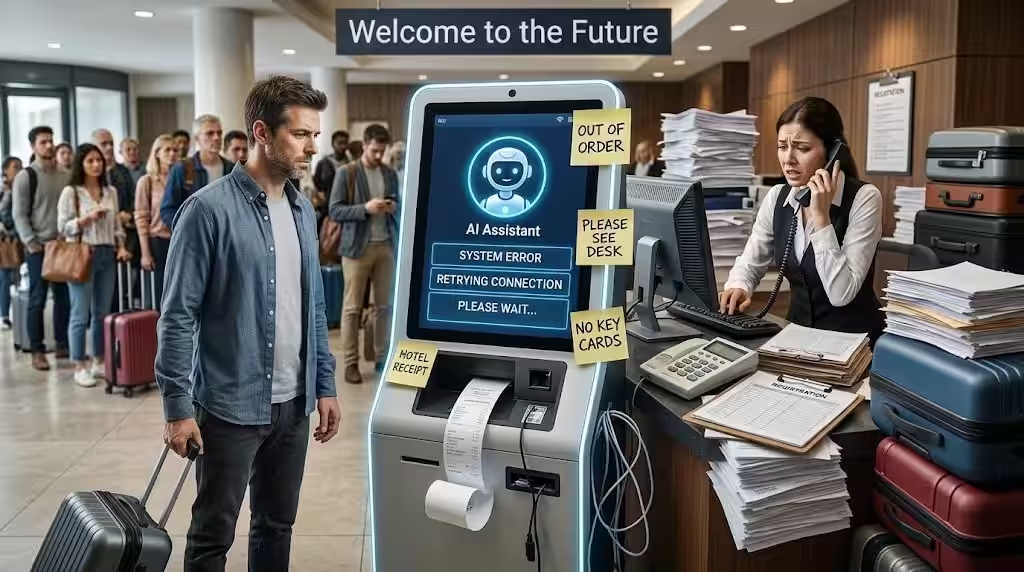
Hospitality is deep into AI adoption. An h2c/Cloudbeds study found 78 percent are already using it and 89 percent plan to expand. But one number matters more: just 6 percent have a comprehensive AI strategy. The technology has arrived faster than the operational readiness.
The mood is changing. Hoteliers have spent years being shown what AI could do. Now they want to know what it actually does. Where does it save money? Where does it improve performance? Where does it make the guest experience better, or an employee better at their job?
There’s work to do here as well: 58 percent of hotel companies measure ROI from AI initiatives, but only 27 percent do it consistently. Measuring that value forces the industry to confront something less exciting: how hotels actually operate.
We’ve all heard “garbage in, garbage out.” Hospitality’s version is particularly difficult. It is the SOP in a shared drive nobody has updated in two years. It is the policy that says one thing while the GM says another. It is information split between a PMS, CRM, inbox, spreadsheet and somebody’s head, or the workaround that became standard practice at one property and never reached the group.
Otelier’s 2026 Hotel Operations Index found 91 percent of operators still rely on manual reporting despite having automation. Only 11 percent have a fully integrated technology stack, and 27 percent run more than seven platforms to operate one property.
Speak with enough operators, and what fragmentation looks like beyond the systems is clear. Ask the same operational question at three properties, and you get three different answers. Ask three general managers, and you might get three more. Nobody is incompetent or obviously wrong. The operation has simply accumulated different ways of doing the same thing.
That worked, imperfectly, when people were the connective tissue. An experienced employee knew which policy was out of date. A GM knew the official process wasn’t quite how things happened on property. The front desk knew who to call when the system and experience disagreed.
AI doesn’t have that institutional instinct; it needs a reliable answer and a way to connect that answer to execution. That is the problem hospitality must solve for AI to deliver at scale. AI interprets more data and puts answers in front of employees instantly. But speed magnifies the importance of the answer being right. If the underlying knowledge is scattered, conflicting, or outdated, AI amplifies that inconsistency.
AI can only work with what it’s given, and much of hospitality has provided it chaos wearing a uniform. That’s why the most important AI work of the next few years will look unglamorous. Which answer is authoritative? Who owns it? When was it last updated? Which properties and roles does it apply to? Can employees find it when the work happens? Can leaders see whether it is being followed, where execution is breaking down, and what must improve?
Those questions determine whether AI becomes useful and whether its value can be measured. Once standards, execution, and performance are connected, the use cases become clearer too. AI should catch an error before it reaches a guest, surface the right answer when an employee needs it, spot patterns a team would miss, reduce repetitive work, shorten resolution times, and show operators what’s happening across their properties. Those are outcomes you can measure.
There has been too much fascination with putting AI in front of the guest because we can. A chatbot answering faster is only an improvement if the answer is right and the experience is better. Automation only helps if the capacity it frees goes somewhere more useful.
Hospitality should aim for AI that makes the operation behind the guest experience substantially better, giving employees greater capacity to do what humans remain exceptionally good at: reading a situation, exercising judgement, solving an unusual problem and making somebody feel cared for.
Sometimes the best outcome of an AI investment is simple: an employee has enough time and enough information to tell a guest, “Here’s my number. Call me if you need anything.” That’s technology earning its place.
The Prediction
AI will separate hotel organizations that can turn reliable operational knowledge into consistent execution from those using technology to scale inconsistency.
The companies that get this right will know their operating standards, govern how they change, deliver them to the right people, and see whether they are being executed consistently. They will use it aggressively where it removes friction, catches mistakes, improves decisions, and gives employees time back.
For everyone else, AI becomes an expensive way of discovering problems that were already there.
The real promise of AI in hospitality is not that guests encounter more technology. It is that the operation works better behind the scenes so employees have greater capacity to deliver the thing this industry ultimately sells: hospitality.
Yipy Blog