A Hospitality Standards Management System (HSMS) is an operational software category that connects brand standards directly to daily shift workflows. Unlike static document repositories (PDFs, Intranets) or periodic audit apps, an HSMS unifies standards definition, role-based mobile distribution, frontline self-assessments, and real-time execution analytics into a closed operating loop across hotel properties.
Hotels do not have a documentation problem. They have an execution problem.
Over the last thirty years, hospitality groups have created thousands of pages of Standard Operating Procedures (SOPs), brand manuals, and service guidelines. Yet cross-shift variance remains one of the largest drivers of guest dissatisfaction, brand erosion, and operational friction.
The breakdown happens in the gap between what corporate leadership documents and what frontline associates execute during a busy shift.
A Hospitality Standards Management System (HSMS) is the software architecture developed specifically to close that execution gap.
What Is the Definition of a Hospitality Standards Management System?
A Hospitality Standards Management System (HSMS) is a centralized platform that operationalizes brand standards, service protocols, and compliance requirements across hotel properties by embedding them directly into daily shift workflows.
At its core, an HSMS connects three fundamental questions for hotel leadership:
- What is expected? (The living source of truth for all brand and operational standards)
- What actually happens? (Real-time visibility into floor-level shift execution and self-audits)
- What needs to improve? (Targeted coaching and closed-loop issue resolution)
Rather than treating brand standards as passive reference materials stored in binders or intranet folders, an HSMS functions as an active operating system on the floor.
Why Do Traditional Hotel SOP Manuals and Audits Fail?
Most hotel groups attempt to drive consistency using a fragmented collection of point solutions:
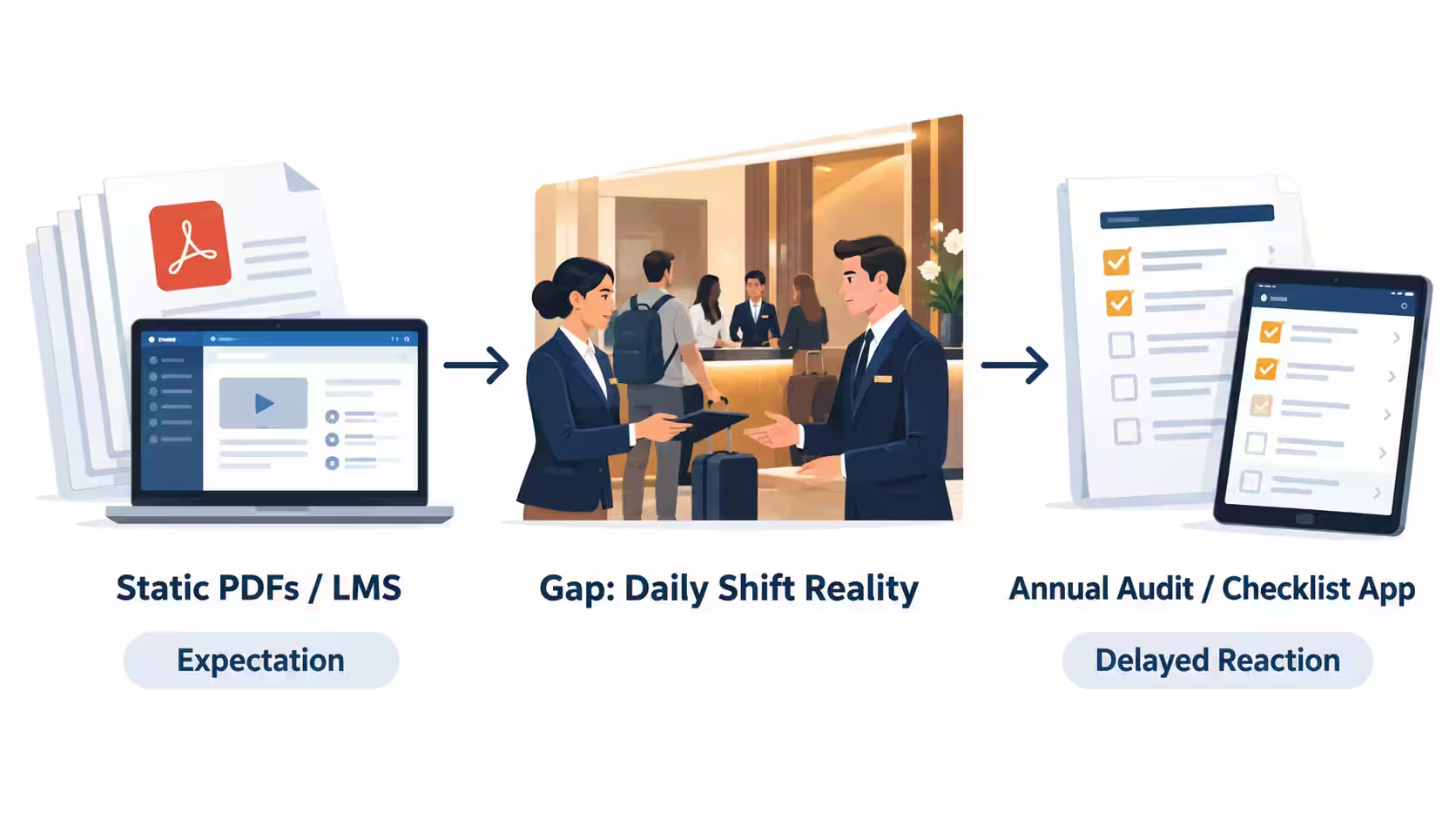
This traditional approach breaks down for three structural reasons:
1. The "PDF PTSD" Phenomenon
When standards are updated at corporate, they are typically exported into massive PDF documents or uploaded to corporate intranets. Frontline associates on a live shift cannot search a 600-page document to verify room staging or check-in sequences. Because information is difficult to find, associates rely on memory or informal habits passed down across shifts.
2. Retrospective Audit Lag
Third-party quality audits (like Forbes, AAA, or brand inspections) happen once or twice a year. The results arrive weeks after inspectors leave property. By the time leadership reviews the failure points, the responsible associates may have changed roles or left the property entirely. Audits measure historical failure; they do not build consistent daily habits.
3. The Shift Handoff Void
Variance compounds when information fails to transfer across morning, evening, and overnight shifts. Without a shared system reinforcing standards shift by shift, consistency becomes dependent on individual managers rather than a repeatable operating system.
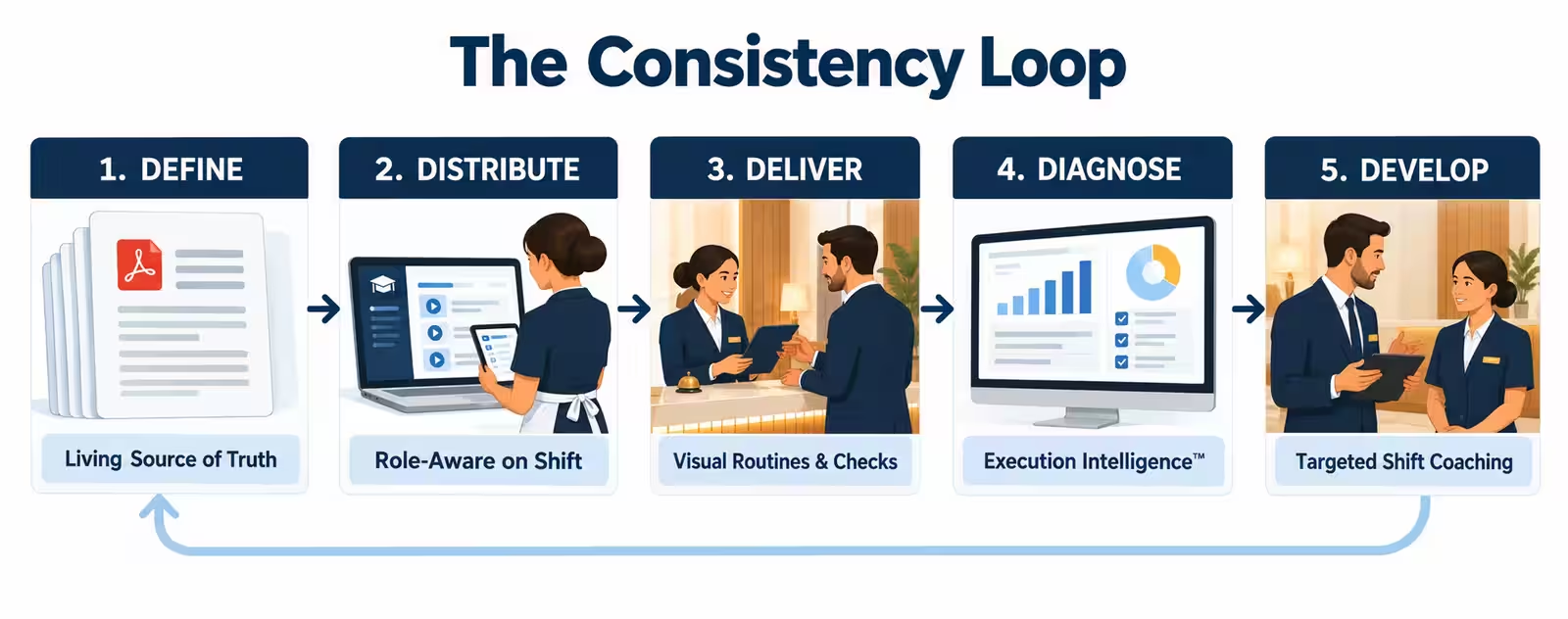
How Does a Hospitality Standards Management System Work? The Consistency Loop
An effective HSMS operates through an end-to-end framework known as the Consistency Loop, moving standards from static documentation into continuous execution:
1. Define: Centralized Version Control
The system serves as a single, living repository for all brand standards, regional requirements, and department SOPs. When a brand standard changes, updates deploy instantly across all relevant tiers without creating competing PDF versions.
2. Distribute: Role-Aware Mobile Guidance
Instead of forcing staff to sift through irrelevant material, the system filters standards by property tier, department, and job title. A housekeeper receives exact room setup standards; a front desk agent sees arrival sequence requirements in their native language with visual references.
3. Deliver: On-Shift Execution & Verification
Associates access concise, visual job aids on mobile devices during shift routines. Managers conduct short, 90-second floor assessments rather than spending hours filling out paper logs.
4. Diagnose: Real-Time Execution Intelligence™
The system analyzes daily audit data and frontline engagement to surface operational variance before it impacts guest reviews. Corporate and regional leaders gain portfolio-wide visibility into recurring problem areas across properties and departments.
5. Develop: Targeted Coaching
Rather than broad, generic retraining programs, managers use real performance data to deliver precise micro-coaching on the exact standards that are slipping on the floor.
HSMS vs. LMS vs. Checklists: What Is the Difference?
Hotel operators frequently ask how an HSMS differs from existing hospitality tech stack components:
| Feature / Capability | Learning Management System (LMS) | Digital Checklist / Task App | Hospitality Standards Management System (HSMS) |
|---|---|---|---|
| Primary Purpose | Onboarding and compliance coursework | Daily task completion tracking | End-to-end standards operationalization and consistency |
| Operational Timing | Prior to shifts (in the back office) | During shift (task-by-task) | Integrated continuously into shift routines and handoffs |
| Content Dynamic | Static video courses and quizzes | Simple yes/no checklist items | Contextual, visual, role-specific standards and protocols |
| Feedback Loop | Completion percentages | Task completion logs | Shift-level execution variance and operational trends |
| Source of Truth | Training modules | Static task lists | Centralized, real-time brand standards repository |
While an LMS teaches an employee during their first week, and a checklist confirms whether a chore was finished, an HSMS ensures that every task is performed according to current brand standards every shift.
What Are the Business Benefits of an HSMS?
Deploying a dedicated system for standards management delivers measurable returns across property operations:
- Lower Cost of Variance: Catching service and maintenance errors before guests check in eliminates comped rooms, service recoveries, and negative TripAdvisor or Google reviews.
- Accelerated Frontline Onboarding: New associates ramp up faster when standards are accessible as visual, role-specific job aids on mobile devices rather than through weeks of manual binder study.
- Higher Audit & Star Rating Scores: Properties running daily automated self-assessments consistently outperform peer properties on Forbes Travel Guide, LQA, and brand inspection benchmarks.
- Reduced Management Burden: Shift leaders spend less time policing routines and compiling paper reports, freeing them to focus on guest service and floor coaching.
Frequently Asked Questions About Hospitality Standards Management
Who uses a Hospitality Standards Management System?
An HSMS is utilized across all tiers of a hospitality organization:
- Frontline associates access visual, translated standards on shift.
- Property managers and GMs conduct rapid floor evaluations and track department variance.
- Corporate VP of Operations and Brand Directors maintain portfolio-wide compliance and push immediate brand updates.
Can an HSMS support multi-brand and international portfolios?
Yes. Modern systems like Yipy are engineered for enterprise scale, enabling global operators (such as Radisson Hotel Group across 1,500+ hotels) to manage multiple brand tiers, regional regulations, and multilingual teams from a single environment.
Does an HSMS replace our existing Property Management System (PMS)?
No. An HSMS integrates into the operational workflow alongside your PMS, task management software, and collaboration tools, acting specifically as the governance and execution system for brand and service standards.
Transform Standards From Binders into Daily Shift Execution
Consistency across hundreds of rooms and multiple shifts is never an accident. It is the result of an operating system.
To see how leading luxury independents and global hotel brands turn static brand manuals into consistent daily performance:
👉 Explore the Hospitality Standards Management System at Yipy.io
Yipy Blog