Snapshot
Property: 376-room Ritz-Carlton resort, luxury tier, perched above the California coast between San Diego and Los Angeles
Role: Mitchel Duggan, Hotel Manager, 23 years with the company, 5th property
Context: Fresh off a major renovation of guest rooms, club lounge, spa, and pool deck, on a journey toward Forbes Five-Star
Tools in play:
- Medallia for guest surveys and top-defect analysis
- Yipy as a new tool for service audits, standards testing, and leadership accountability
The Challenge: Static audits that didn't move the needle
Before Yipy, the resort already had an audit program in place—a legacy software system designed to run service audits.
On paper, the box was checked. In practice, it didn't do what they needed.
Mitchel describes the limitation clearly:
"We had an audit program… that was pretty static and didn't really collate too much of the information without somebody having to go in and drill through and pull out the relevant information."
"You're really just capturing the function of performing the audit, not necessarily digging into the effectiveness of conducting audits, the testing piece of testing your team against the standard."
The pain wasn't that people were openly complaining; it was more subtle and more dangerous:
- Audits weren't driving behavior change.
- If he didn't push audits, they didn't happen—and it "wasn't going to make a difference" with the old system.
- Leadership couldn't easily see:
- Which departments were participating
- Which standards weren't being met
- Where to focus training and coaching
As Mitchell puts it:
"It wasn't the most effective system… it wasn't moving the needle far enough for us."
At the same time, the resort already had a robust guest survey engine in place:
- Medallia provided deep insight into guest feedback and "top defects" by resort and by department.
- They could slice and dice guest sentiment "all day long."
What Medallia didn't do was test people against standards in real time or close the loop between standards, training, and daily execution.
That's the gap Yipy stepped into — and it's the same structural reason hotel audits alone aren't enough to create consistency.
The Context: A Forbes-driven, training-heavy culture
This isn't a hotel trying to "fix" a broken culture. It's a high-performing luxury resort with:
- A long-standing Ritz-Carlton culture
- Very low turnover for a luxury property
- "Founding members" with 41 years on property
- Restaurant team members with 12–15 years of tenure
- Strong existing training rhythms
Mitchell describes the environment:
"We do daily lineups. We have a strong training program with Forbes. We bring in Forbes trainers and we run our ladies and gentlemen through their paces in the Forbes training several times a year."
Service expectations are high. The aspiration is clear:
"We're on a journey to get the Forbes Five-Star."
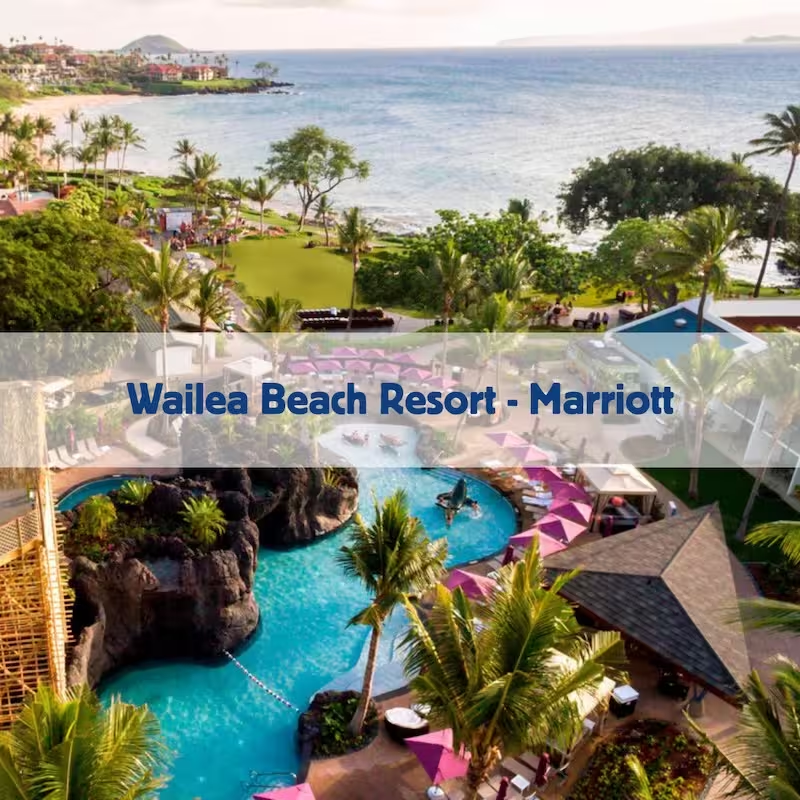
It's a journey we've seen other luxury properties run — most notably Wailea Beach Resort, which posted the highest Forbes score in property history using the same approach.
They already know what standards they want. The challenge is:
- Constantly training new "Ladies and Gentlemen"
- Holding people to those standards
- Ensuring they truly understand the expected service delivery
Mitchell sums it up:
"The only way you really get fluent in delivery at a luxury level is by constant training and reinforcing steps of service."
They needed a tool that would support that continuous testing and coaching loop, not just record that an audit occurred.
Why Yipy: A more effective way to test against standards
The resort heard about Yipy from another property and started conversations as they closed out the previous year. At a large company, nothing gets added without clearing a several layers of approval:
- Security and privacy reviews
- Scalability considerations across all brands
- Multiple approvals to allow access into their systems
Mitchell was involved in the process and saw early on what made Yipy different when compared to their legacy program:
"We had an audit program… pretty static… the system we previously had just doesn't have the bandwidth or the capability to really make it effective at that level."
"[With Yipy] you can get to quite quickly… what departments are actually participating and then even further drilling down as to what standards are just not being met, whether in one department or across the entire property."
Where the old tool captured the existence of audits, Yipy offered:
- Visibility by department
- Visibility by standard
- Visibility by individual
- Flexibility to run:
- Full, end-to-end journey audits
- Smaller audits focused on specific aspects of service delivery
Mitchel's verdict:
"I clearly saw that this could be a game changer for us."
They went live on June 1, and as of the interview they were still in the ramp-up and learning phase.
Implementation: Onboarding, training, and leadership alignment
Mitchel describes onboarding as positive and well-supported:
- Yipy has a designated team for onboarding.
- The team was "communicative and responsive."
- One team member came out to the West Coast and conducted an in-person training class with their leaders.
"They gave us a lot of hands-on attention."
He's quick to note that the bigger challenge isn't the tool—it's getting leaders to prioritize a new discipline:
"The challenge always is you're trying to move a leadership team who have multiple deliverables… The quality aspect of the service delivery, while extremely important, there are many other demands. So it's getting the team to focus enough to say, 'Hey, we got something new and we need to take this on and move it forward.'"
He's clear-eyed about where the work lies:
"I think the execution, the ramp-up challenges fall more so on our side than on Yipy's side. It's engaging the team to be on board that this is the way we're moving forward."
How they're using Yipy today
A. As a quality and testing discipline
Inside the hotel, Yipy is:
- A closed-loop tool used at property level (not yet above property)
- Pulled regularly by a quality leader who:
- Extracts reports
- Assigns expectations for leaders on how many audits they should be doing
"We have a quality leader who is pulling the reports and digging in. We have assignments for leaders and the number of audits they should be doing with their team."
They're actively tweaking and optimizing audit content:
- Some audits are long, end-to-end journey flows (e.g., arrival from driveway to room).
- Mitchell wants to break them down into shorter pieces for different roles (doorman, desk agent, bellman) to make execution faster.
"When I go and do some of the audits myself, the team put in the full audit for arrival… if you follow that the whole way through, it's a 15–20 minute audit… You may only really need 15 of them [items] to do the doorman's part and another 20 to do the desk agent's part. That's something we've got to go back to Yipy with."
B. As part of induction and certification
They've woven Yipy into their onboarding and certification process:
- Learning coaches (highly proficient "Ladies and Gentlemen" who help train others) use Yipy for role certification.
- New hires must reach 95% of the points required on a Yipy audit as one of the final induction steps.
"When we have our learning coaches certify somebody, they must use Yipy to do a certification and they must get to 95% of the points required. That is kind of one of the last tick marks on the induction."
The intent:
- Normalize audits from day one.
- Set the service expectation "up here" rather than allowing people to coast at basic functional execution.
"It helps set the expectation on the service delivery when people arrive in… When you bring them straight out of their induction… they already had to get out of their induction process to be certified in a role as they were audited."
If someone falls short, the answer isn't punishment—it's another rep:
"If they've failed it, that just means they would have to do another one within rapid succession to make sure we've addressed what they missed."
C. As a leadership visibility and coaching tool
Yipy's biggest value for Mitchel is operational visibility:
"It is a wonderful tool to help you really understand where you are with your service delivery and gives you the flexibility and the knowledge to know what's going on in any one of the departments."
"I can drill it down to department. I can drill it down to individual. Or I can take it universally as a hotel and look strategically at where I need to put my efforts to move the needle forward."
Leaders are:
- Getting more comfortable conducting audits
- Using them to "celebrate successes" and "highlight areas of focus"
"I think they're getting more comfortable with the execution of doing the audit and celebrating the successes and highlighting the areas of focus."
And frontline reaction?
They've built a culture where audits are expected and framed as developmental, not punitive:
"We telegraph to the Ladies and Gentlemen that we are going to do the audits. It is part of our culture."
"It's not a game of gotcha… It's more so where do we need to be more effective in helping them understand their role."
They even use peer involvement:
"You could have Ladies and Gentlemen do audits on each other or even have learning coaches support it as well. So it's not always a leader. You never want to create a 'them against us' kind of thing."
Early progress and honest constraints
Mitchel is candid about where they are:
- The property went live with Yipy on June 1.
- They are still in a learning and ramp-up phase.
- They have seen score improvements, but he attributes that to multiple factors:
- Completion of noisy renovation work
- A new "stunning guest room product"
- A lot of "pluses" in their world
"Our scores have improved… but I couldn't define Yipy as the only thing that's helping us right now."
Even so, he's clear on the value:
"To me it is a tool that we have that we just need to use more of that will help us get to where we need to."
What users are saying about Yipy
From leaders and learning coaches:
- Intuitive: "It's intuitive. It's easy."
- Mobile-friendly: While not a native app, the mobile icon and experience make it feel app-like.
- Flexible: Audits can be done on phone and edited later on computer.
"It is quite functional in the icon that you can bring up on your phone. So it functions like an app… It's easy to operate on your phone… and then you can go back and do some edits on your computer."
From Mitchell, summarizing his perspective:
"I'm very happy with the process and system. The team has been very supportive. Their luxury experience and knowledge certainly speaks to them understanding our world. We're speaking the same language."
He also appreciates that the product itself is evolving:
"They're still developing… still adding things, reports, functionality. There's new iterations and ideas coming."
Conclusion: A tool that strengthens a strong culture
This Ritz-Carlton resort didn't turn to Yipy because something was broken. They already had:
- A deep service culture
- Long-tenured teams
- Strong training rhythms
- Clear quality aspirations
What they lacked was a tool that matched their ambition—something that could help leaders test standards consistently, see what was really happening on the floor, and coach their people toward the level of excellence they expect.
Yipy is becoming that tool.
Not a replacement for culture.
Not a shortcut to luxury.
But an operational discipline that gives a world-class team:
- A clearer view of how standards are landing
- A way to test and coach more effectively
- A structure to onboard new people at the right level
- A shared language for what "great" looks like
In Mitchel's words:
"It is a tool that we have that we just need to use more of that will help us get to where we need to."
For a resort on a journey to Five-Star service, that's the point: Yipy isn't the destination. It's the vehicle that helps a great team get further—faster, clearer, and with greater confidence in every step of the experience.
Visit yipy.io to explore how the world's first Hospitality Standards Management System transforms standards chaos into consistent excellence.
Yipy Case Study: Ritz-Carlton Laguna Niguel